McVAMP: Vectorizing Projection in Manifold-Constrained Motion Planning for Real-Time Whole Body Control

Purdue University

McVAMP solves manifold-constrained motion planning problems in milliseconds, providing the ability to generate feasible motions while reacting to dynamic environments. Here, we show McVAMP solving a plane-constrained planning problem in a dynamic maze environment, by globally replanning in response to changes in the environment.

Abstract

Many robot planning tasks require satisfaction of one or more constraints throughout the entire trajectory. For geometric constraints, manifold-constrained motion planning algorithms are capable of planning a collision-free path between start and goal configurations on the constraint submanifolds specified by the task. Current state-of-the-art methods can take tens of seconds to solve these tasks for complex systems such as humanoid robots, making real-world use impractical, especially in dynamic settings.

Inspired by recent advances in hardware accelerated motion planning, we present a CPU SIMD-accelerated manifold-constrained motion planner that revisits projection-based constraint satisfaction through the lens of parallelization. By transforming relevant components into parallelizable structures, we use SIMD parallelism to plan constraint-satisfying solutions.

Our approach achieves up to 100 to 2000x speed-ups over the state-of-the-art, making real-time constrained motion planning feasible for the first time. We demonstrate our planner on a real humanoid robot and show real-time whole-body quasi-static plan generation.
Video

Methodology

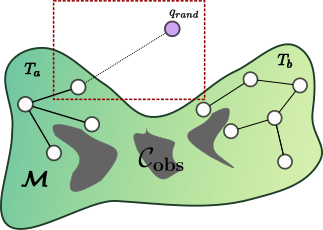
We implement a vectorized manifold-projection operator that performs the motion-extension and validation for a constrained RRT-connect planner. By using SIMD parallelism, we are able to perform the projection step for multiple samples in parallel along a connection vector, which significantly speeds up the projection step and helps invalidate infeasible solutions faster, allowing us to solve complex constrained planning problems in milliseconds.

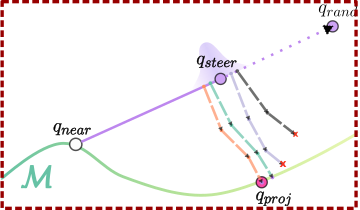
Constrained extend step towards random sampled configuration
(a) Constrained Extend step towards random sampled config
Multiple candidate projections around sampled point
(b) Multiple candidate projections around sampled configuration
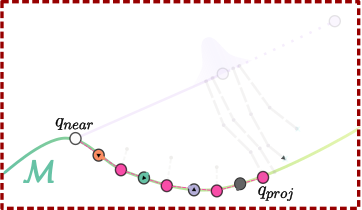
Recursive interpolation and projection up to desired resolution
(d) Recursive interpolation and projection up to desired resolution
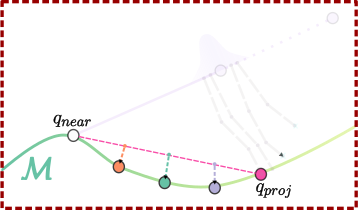
Vectorized projection of interpolated configurations
(c) Vectorized projection of interpolated configurations

Results

7-DoF Franka Emika Panda Arm End Effector Constraint

A 7-DoF Franka Emika Panda arm with an end effector pose constraint. Here we demonstrate the planner's ability to conform to position and orientation constraints while solving complex motion planning problems in the presence of obstacles.

30-DoF Humanoid Digit Robot Multiple Constraints

A 30-DoF humanoid robot transporting a box with multiple constraints: (i) Feet fixed to the ground, (ii) Relative pose constraint between the hands, (iii) Closed link constraint at the knees, and (iv) Center of mass within the support polygon. The robot is able to react to dynamic obstacles in the environment while maintaining all constraints.

Performance

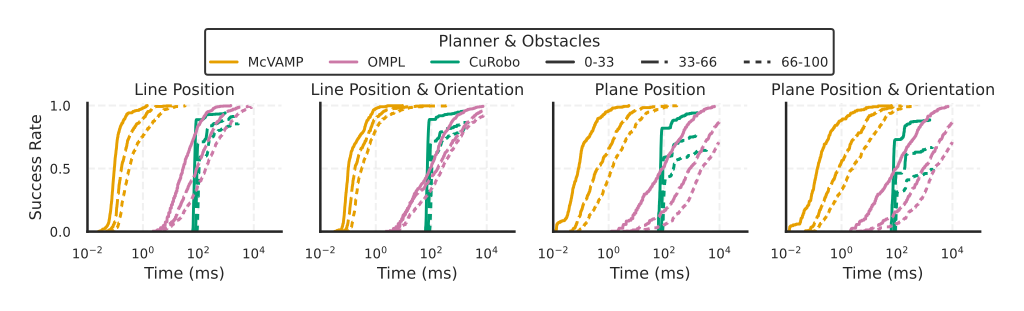
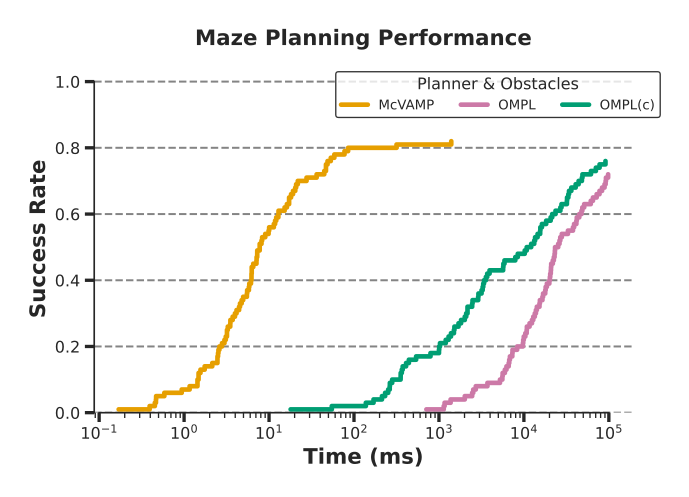
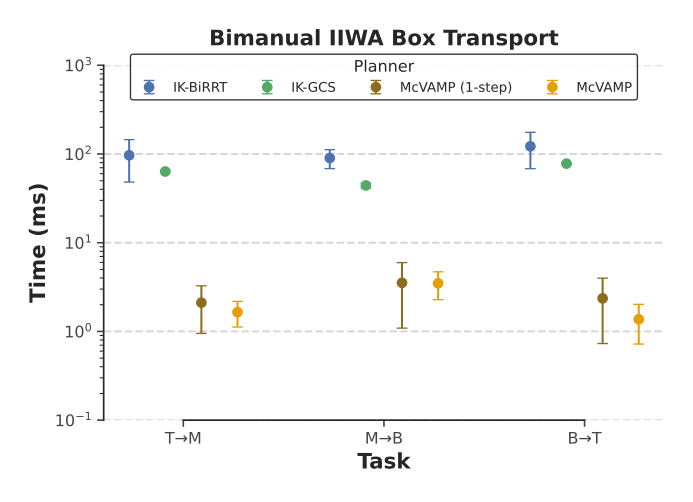
Quantitative comparisons across planning tasks are shown below for the 7-DoF Panda arm and a 14-DoF bimanual IIWA arm.

7-DoF Panda line and plane constraints comparison plot
(i) 7-DoF Panda for line and plane constraints comparison
Maze benchmark comparison plot
(ii) Solving a maze benchmark
Bimanual transport problem comparison plot
(iii) Bimanual transport problem comparisons

BibTeX (preprint)

@article{chen2025spasm,
    author={Lucas Chen and Shrutheesh R. Iyer and Zachary Kingston},
    title={Differentiable Particle Optimization for Fast Sequential Manipulation}, 
    year={2025},
    eprint={2510.07674},
    archivePrefix={arXiv},
    primaryClass={cs.RO},
    url={https://arxiv.org/abs/2510.07674}, 
}