Yitian Gao
Ph.D. Student
(he/him)

I am a Ph.D. student at Purdue University with an interest in AI and robotic motion planning. Specifically, I specialize in kinodynamic planning such as for soft vine robots, nonprehensile manipulation, and dynamic systems.
2026
- Fast Asymptotically Optimal Kinodynamic Planning via VectorizationIn IEEE/RSJ International Conference on Intelligent Robots and SystemsTo Appear
Sampling-based motion planners have been shown to be effective for systems with complex kinodynamic constraints and high dimensionality. However, these algorithms struggle to achieve real-time performance, leading to recent efforts to parallelize planning. While GPU-accelerated planners have achieved significant speedups, existing approaches require specialized CUDA programming that limits accessibility and portability. We present Parallel Asymptotically Optimal Kinodynamic RRT (PAKR), a massively parallel kinodynamic planner leveraging JAX and the XLA compiler to achieve GPU acceleration through standard Python tooling. By combining our parallel planner with the AO-x meta-algorithm, we achieve asymptotic optimality through fast iterative replanning. We provide a theoretical analysis of probabilistic completeness, analyze the effects of batch size and branching factor on convergence, and demonstrate scalability to complex dynamics using the MuJoCo-XLA simulator. Experiments show competitive runtimes with state-of-the-art GPU planners and superior solution quality.
@inproceedings{gao2026pakr, author = {Gao, Yitian and Lu, Andrew and Kingston, Zachary}, booktitle = {IEEE/RSJ International Conference on Intelligent Robots and Systems}, note = {To Appear}, title = {Fast Asymptotically Optimal Kinodynamic Planning via Vectorization}, year = {2026} } - SoRoParallel Simulation of Contact and Actuation for Soft Growing RobotsYitian Gao*, Lucas Chen*, Priyanka Bhovad, Sicheng Wang, Zachary Kingston, and Laura H. BlumenscheinSoft Robotics
Soft growing robots, commonly referred to as vine robots, have demonstrated remarkable ability to interact safely and robustly with unstructured and dynamic environments. It is therefore natural to exploit contact with the environment for planning and design optimization tasks. Previous research has focused on planning under contact for passively deforming robots with pre-formed bends. However, adding active steering to these soft growing robots is necessary for successful navigation in more complex environments. To this end, we develop a unified modeling framework that integrates vine robot growth, bending, actuation, and obstacle contact. We extend the beam moment model to include the effects of actuation on kinematics under growth and then use these models to develop a fast parallel simulation framework. We validate our model and simulator with real robot experiments. To showcase the capabilities of our framework, we apply our model in a design optimization task to find designs for vine robots navigating through cluttered environments, identifying designs that minimize the number of required actuators by exploiting environmental contacts. We show the robustness of the designs to environmental and manufacturing uncertainties. Finally, we fabricate an optimized design and successfully deploy it in an obstacle-rich environment.
@article{gaochen2025actsim,
  author = {Gao, Yitian and Chen, Lucas and Bhovad, Priyanka and Wang, Sicheng and Kingston, Zachary and Blumenschein, Laura H.},
  doi = {10.1177/21695172261425906},
  journal = {Soft Robotics},
  title = {Parallel Simulation of Contact and Actuation for Soft Growing Robots},
  year = {2026}
}
2025
- RoboSoft
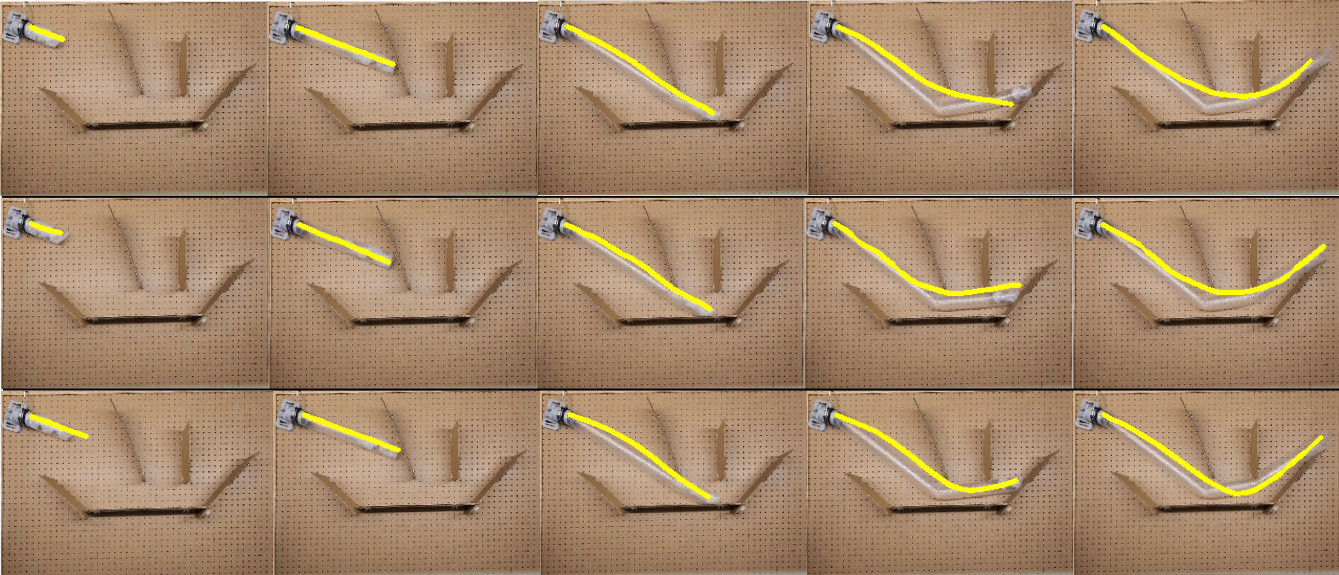 Physics-Grounded Differentiable Simulation for Soft Growing RobotsLucas Chen*, Yitian Gao*, Sicheng Wang, Francesco Fuentes, Laura H. Blumenschein, and Zachary KingstonIn IEEE-RAS International Conference on Soft Robotics
Soft-growing robots (i.e., vine robots) are a promising class of soft robots that allow for navigation and growth in tightly confined environments. However, these robots remain challenging to model and control due to the complex interplay of the inflated structure and inextensible materials, which leads to obstacles for autonomous operation and design optimization. Although there exist simulators for these systems that have achieved qualitative and quantitative success in matching high-level behavior, they still often fail to capture realistic vine robot shapes using simplified parameter models and have difficulties in high-throughput simulation necessary for planning and parameter optimization. We propose a differentiable simulator for these systems, enabling the use of the simulator "in-the-loop" of gradient-based optimization approaches to address the issues listed above. With the more complex parameter fitting made possible by this approach, we experimentally validate and integrate a closed-form nonlinear stiffness model for thin-walled inflated tubes based on a first-principles approach to local material wrinkling. Our simulator also takes advantage of data-parallel operations by leveraging existing differentiable computation frameworks, allowing multiple simultaneous rollouts. We demonstrate the feasibility of using a physics-grounded nonlinear stiffness model within our simulator, and how it can be an effective tool in sim-to-real transfer. We provide our implementation open source.
@inproceedings{chengao2025diffsim,
  author = {Chen, Lucas and Gao, Yitian and Wang, Sicheng and Fuentes, Francesco and Blumenschein, Laura H. and Kingston, Zachary},
  booktitle = {IEEE-RAS International Conference on Soft Robotics},
  doi = {10.1109/RoboSoft63089.2025.11020809},
  pages = {1--8},
  title = {Physics-Grounded Differentiable Simulation for Soft Growing Robots},
  year = {2025}
}
